

New BIMSTOK. New Future: Simplifying Infrastructure Maintenance for Safety.
September 16, 2025

Supporting Safe Infrastructure Through the Power of IT
Before I founded Early Reflections, I encountered the infrastructure and construction industries during my time as an executive at a publicly listed IT company. When our company acquired a consulting firm specializing in dam and river engineering, I was appointed to the board of directors for that business. Through this experience, I became aware of the serious problems in Japan’s infrastructure industry, which later inspired the development of BIMSTOK at Early Reflections.
One of the fundamental issues is the over-dependence on individual expertise. The work demands years of experience and specialized knowledge; what people learn often stays with them rather than being shared. As a result, critical know-how accumulates in the heads of experienced members instead of being passed along to colleagues.
How challenging is it to work as an infrastructure engineer? First, engineers are expected to hold a Professional Engineer (PE) license, which requires at least seven years of experience before one can even sit for the exam. Government agencies evaluate contractors based on the number of licensed engineers they assign, so the pressure to qualify is considerable. At the same time, every task—from inspection to repair—must comply with detailed safety and quality standards. Reporting is exhaustive, which makes information management another challenge.
Demographic and structural pressures compound the problem. Japan's declining birthrate and aging population mean that fewer people are available to do this work. Meanwhile, much of the nation's infrastructure was built during the postwar economic boom of the 1950s to 1970s and is now deteriorating. We are already seeing serious accidents, such as the road collapse in Yashio City, Saitama, in January 2025. When I saw dedicated engineers working so hard to keep people safe, I felt both respect for their commitment and concern that the entire system depended too heavily on their personal dedication.
As a director of a construction consulting company backed by an IT corporation, I believed that information technology, artificial intelligence, and data science could help solve this problem. This made me consider developing an innovative product to streamline infrastructure maintenance and management, which eventually grew into the concept of today’s BIMSTOK.
The Key to Addressing Infrastructure Challenges: BIM/CIM
Facing the challenges of Japan’s infrastructure industry, I initially aimed to promote digital transformation (DX) by applying AI and data science to tasks such as aerial photo analysis, dam flood forecasting, and river flow modeling. While working with engineers involved in some of the country’s most representative dams, I came to recognize more specific challenges in the field: preparing inspection reports under strict regulations consumed an enormous amount of time; making sense of 2D drawings without years of experience was almost impossible; and critical information was often not properly shared in a way that successors could readily understand.
Around then, I learned about BIM (Building Information Modeling) and CIM (Construction Information Modeling). In April 2020, Japan’s Ministry of Land, Infrastructure, Transport and Tourism (MLIT) announced that BIM/CIM would become the standard for nearly all public works by 2023. BIM/CIM integrates 3D models of buildings and civil structures with associated data, streamlining processes from design to maintenance. This approach seemed particularly useful for structure maintenance and management, as it allows all related information, including defects and inspection history, to be easily organized and visually understood, unlike traditional 2D drawings.
At that time, most DX solutions in the infrastructure industry had focused on construction management rather than maintenance, and no BIM/CIM-based tool for ongoing maintenance and management existed in Japan. Furthermore, the BIM/CIM software available at that time was often difficult to use and required powerful computers. Information should be accessible to everyone involvedーfield engineers, administrative staff, and othersーso they can spend more time on essential work instead of searching through disordered data. That conviction marked the start of BIMSTOK's development.
What is BIMSTOK?
BIMSTOK is a cloud-based platform built on BIM/CIM principles. Its goal is to make accessing information quick and effortless. Designed to be search-free and easy to navigate, it connects BIM/CIM models with all types of maintenance and management data.
When reporting an issue or abnormality, field personnel typically use photos or 2D drawings to describe what happened and where it happened. Because these materials are in different formats, misunderstandings arise, and the information becomes difficult to manage. Using a BIM/CIM model, on the other hand, enables everyone to understand the situation from the same perspective, making the information much easier to share and use. BIMSTOK allows users to review contextual information across previous reports and to extract and organize specific data more effectively.
Why BIMSTOK Needed to Change
We released the first version of BIMSTOK in November 2023 with the idea of creating a flexible system that integrates information with BIM/CIM models.
At that stage, however, BIM/CIM was not widely used in maintenance, so the concept did not resonate. As a result, we pivoted toward making existing operations easier and focused on optimizing workflows. While this approach encouraged adoption, it limited flexibility and strayed from our belief that systems should adapt to changing environments and practices. As interest in BIM/CIM has grown and our engineering team has expanded, we decided to return to our original aim of flexible integration. This led to a substantial redesign.
Two years ago, this would have sounded challenging. Now, we have a stronger and more diverse team. The recent updates were led by an international team, including a lead product engineer from the Philippines, an engineer from the U.S. with expertise in high-performance computing (HPC), 3D visualization, and artificial intelligence (AI), and a group of young members studying advanced computer science in the Philippines.
Development was conducted entirely in English, with a high degree of momentum and efficiency.
Evolving BIMSTOK: Smarter, More Flexible, Easier to Use
What is new BIMSTOK like? Let’s look at the details.
First, the viewer has become more powerful, offering a richer variety of visualization options. In addition to cross-sectional views and selective element visibility, we have added first-person views, enabling users to virtually explore structures and inspect details as if they were on-site.
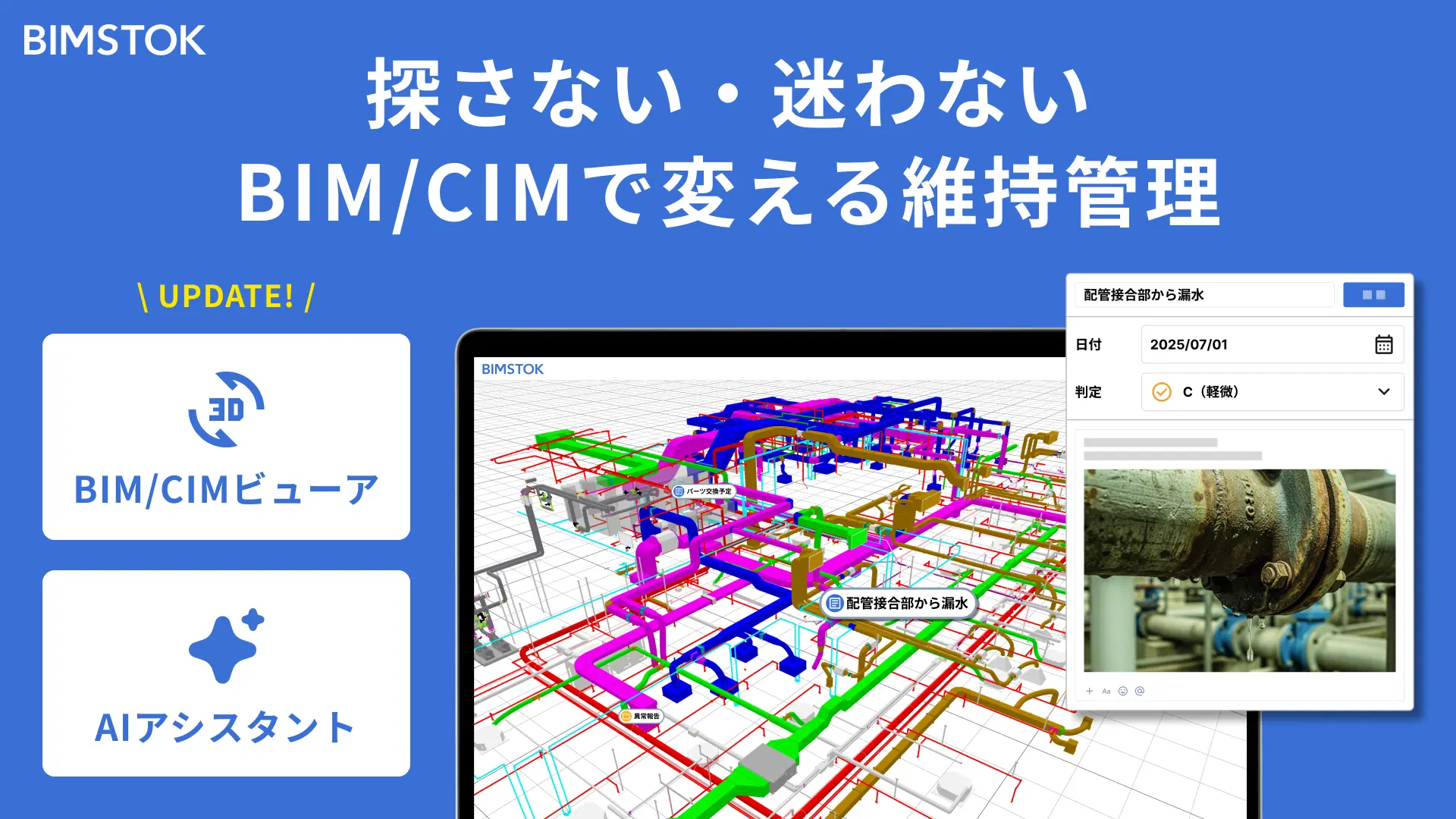
Second, it became easier to find relevant information on BIM/CIM models. All fundamental data of facilities is linked to BIM/CIM models and can be accessed directly within the 3D interface. You can also add notes, reports, and links as needed.
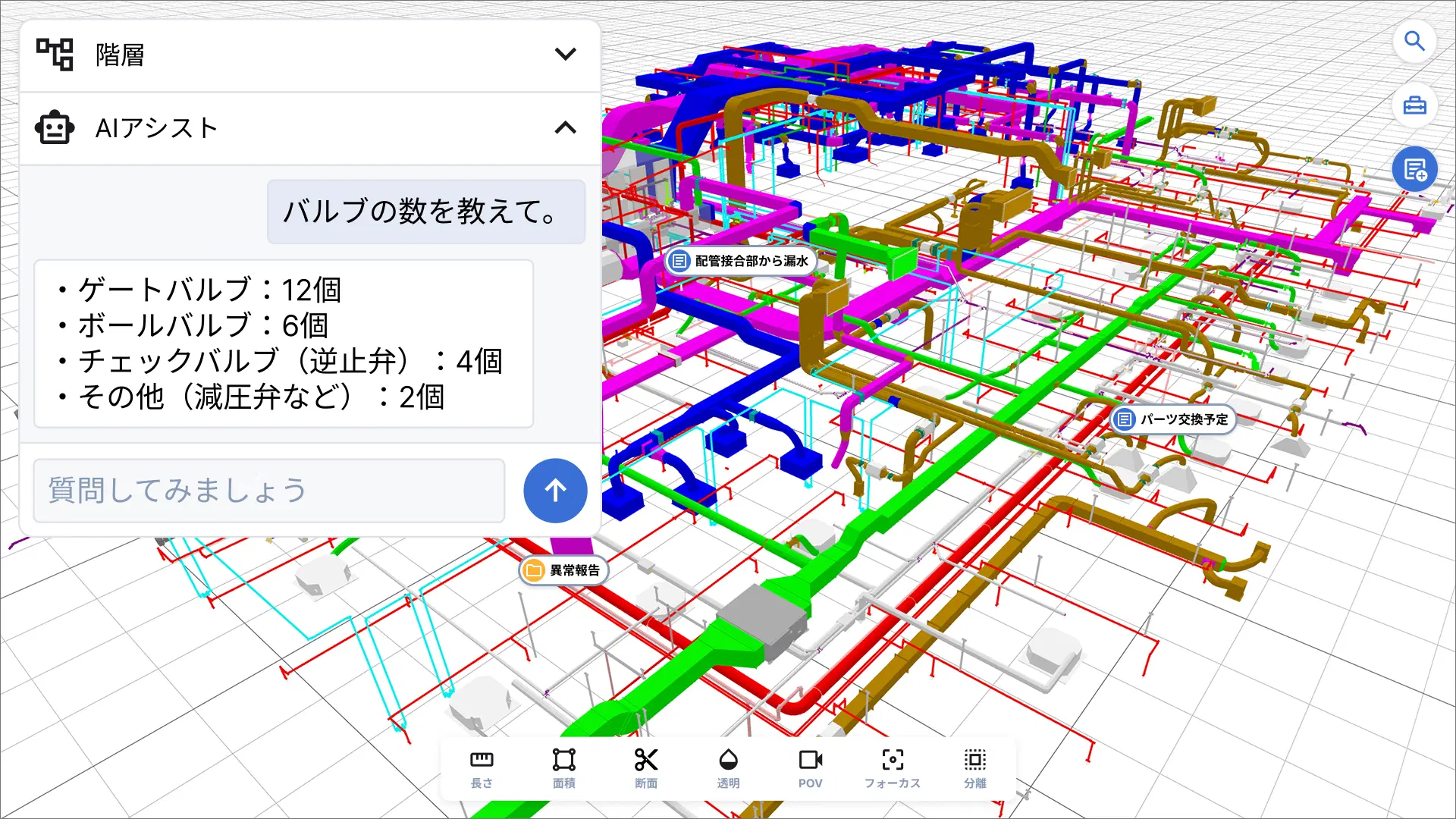
Another key update is AI integration. The AI assistant can summarize facility information, help answer common questions, and interact with BIM/CIM models. In addition to cloud-based AI, we plan to offer multiple LLM (Large Language Model) options in the future, including on-premise LLMs and our own in-house solutions, allowing clients to choose based on their security requirements.
At Early Reflections, we view AI as a key tool to empower IT to become a “true IT”. This is because we believe that systems should eventually be capable of operating automatically. This philosophy supports our proactive adoption of AI-driven approaches.
Thanks to these updates, BIMSTOK has become significantly more flexible. While infrastructure has always been our primary target sector, this evolution allows us to serve a wider range of users, including building management and real estate asset management professionals.
The Future BIMSTOK Strives to Create
Our mission at Early Reflections is “to become the early reflections of world-changing ideas” and “to enable humanity to devote more time to philosophy through information technology and data analysis.” Here, “philosophy” is a metaphor for thoughtful and strategic work.
BIMSTOK reflects this mission into practice. By automating routine tasks through AI and integrating data across systems, BIMSTOK optimizes workflows in infrastructure maintenance. This allows professionals to focus on critical tasks such as decision-making and strategic planning rather than repetitive work.
Being able to visualize and verify things leads to peace of mind. When the people who work passionately on the ground every day can feel assured, that sense of security extends to our entire society. I believe that the use of BIM/CIM and BIMSTOK will eventually contribute to enhancing the safety of infrastructures in the future.
We are developing BIMSTOK without relying on external funding. This independence allows us to focus on steady, long-term improvements rather than short-term returns, ensuring we continue to deliver a product that truly adds value. We also see potential beyond maintenance. We envision the platform’s data-driven capabilities to support strategic facility management and provide actionable recommendations based on comprehensive management data. Inquiries about these possibilities are already coming in.
Interest has also emerged overseas. After a recent press release, a company in France contacted us. To prepare for a wider audience, we built an international development team and added multi-language support. Eventually, we hope BIMSTOK will help improve the safety and reliability of infrastructure around the world.
Infrastructure forms the foundation of safety and security in our daily lives. BIMSTOK will continue to evolve to meet real-world needs, serving as a trusted platform that sustains this sense of assurance and carries it forward to the next generation.
Thank you for reading. You can learn more about BIMSTOK on the following website: